
Information-on-Demand with Microsoft Teams Chatbot
Microsoft’s Power Virtual Agents facilitates businesses to respond rapidly to the needs of their employees and customers. It is a low-code, GUI-driven solution that empowers your team to create rich, conversational chatbots that easily integrate with the Teams platform.
In this post, we are going to demonstrate a working chatbot that can provide simple answers to common questions.
Licensing
Here is a big surprise! If you have a Microsoft Teams license, you don’t have to pay anything extra!!!
The basic features required to implement and deploy the Microsoft Power Virtual Agent within the Microsoft Teams environment are already included in your Teams license.
So, if you are using any Microsoft 365 plan, such as the Microsoft 365 Business Basic, Business Premium, or Microsoft 365 E1, E3, or E5, the ability to use the Power Virtual Agents inside Microsoft Teams is already included in your license.
There are some limitations, but those limitations should not affect your ability to use this feature in most cases.
Background
The Microsoft Power Platform is the de facto interface to your data inside the Microsoft 365 ecosystem.

To create and deploy the chatbot, we use these four components:
- Dataverse – this is where our data resides
- Power Apps – this is the interface we use to query the data
- Power Automate – this facilitates the flow of data between the Dataverse, Power Apps, and Power Virtual Agents
- Power Virtual Agents – the bot framework that we use to create and deploy our chatbot
The Process
The entire process of creating and deploying the chatbot is accomplished inside the Microsoft Teams environment.
Here are the most important steps:
- Create the required table and import the data into the Microsoft Dataverse (or use SharePoint List)
- Enable Power Virtual Agent and Power Apps in Teams
- Start the bot-building process using the Power Virtual Agent experience inside the Microsoft Teams
- Connect to the Dataverse and query the data using Microsoft Power Automate flow, also inside the Microsoft Teams environment
- Return the output to the chatbot
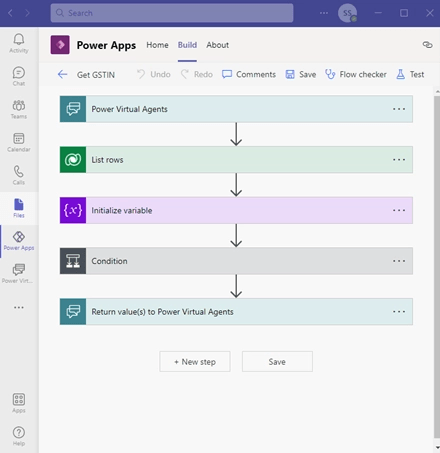
The process is easy, but it does require a technical background, and thus it is not practical to walk you through the entire process in a single post like this. If you want a complete walkthrough, please check the links in the Useful Links section.
Examples
We have named our chatbot XT1. It has built-in natural language processing. Members of the Team can interact with this bot and get answers to simple questions. For example, the bot can fetch the GST number, PAN (Permanent Account Number), address, etc. of any client in our system.
You can see the bot in action in the Animated GIF below:

Chatbots can do a lot more than what you see in these examples. For example, we can have a chatbot that can fetch “Top 5 receivables” from your accounting system with the help of Power BI.
Important Factors to Consider
- The Microsoft 365 license allows 2 GB of space per environment; this is enough for most use cases, but if you use binary objects such as images and PDFs in your flows, you will quickly run out of space
- Each tenant can have a maximum of 5 environments, plus one additional environment for every 20 licensed users; so, if you have 40 licensed users, you can have up to 7 environments and up to 14 GB of data inside Dataverse
- There is no limit on the number of bots you can create, but you can deploy the bot only inside Microsoft Teams
- If you want to deploy bots in other environments outside of Microsoft Teams (such as a website), you must upgrade to a premium license
- The bot can fetch data from various data sources in addition to the Dataverse; however, external data sources such as SQL Server require a premium license
- You can buy additional storage only if you upgrade to a premium license
- February 21, 2025
Essential Cybersecurity Measures for 2025
If you are reading this, you probably already know that IT teams will face even greater cybersecurity challenges in 2025 than they did in 2024. Let us explore the four… - November 20, 2024
The Evolving Role of Managed Service Providers (MSPs) in SMB
MSPs like ForNext Technologies are not just IT support providers; they are growth partners. By addressing challenges and unlocking opportunities, we help SMBs focus on what they do best—running their… - August 23, 2024
How Small Companies Can Build an Effective Cybersecurity Training Program
By developing a robust employee cybersecurity training program, small businesses can significantly reduce risk and build a culture of vigilance. - July 10, 2024
SharePoint Online vs. OneDrive: Choosing the Right Tool for Your Team
In this blog post, we will delve into the differences between OneDrive for Business and SharePoint Online, highlighting why OneDrive is great for small teams and personal use, while SharePoint… - May 17, 2024
Supercharge Your Productivity with these Free Desktop Applications
Here is an extensive list of some of the best free productivity applications for PCs that will definitely help you boost your productivity and optimize your performance. - April 3, 2024
Email Authentication with SPF, DMARC, and DKIM
The importance of email authentication mechanisms - SPF, DMARC, and DKIM, for protection against email-based threats such as spoofing. - February 23, 2024
Why Should You Protect Your VPN with MFA
In this post, we explore the reasons why you should protect your VPN with MFA to ensure trusted access to your IT resources. - February 12, 2024
FREE: Migrate Your Emails and Data to Microsoft 365
A FREE Next-Generation Firewall (NGFW) solution to safeguard your network and increase productivity, including free 1-year technical support. - February 9, 2024
Zero Trust Architecture
In this post, we explore the "Zero Trust" Architecture. We will see why this "never trust, always verify" approach has become so important in the present IT landscape. We will… - January 31, 2024
The True Benefit of Outsourcing Your IT
When you hire an outside agency to manage the IT operations of your company, what would be the most important benefit you will get from it?
- Disclaimer
Company names, products, logos, trade marks and any other proprietary intellectual property or otherwise belongs to the rightful owner, which is not us. You should not assume, even if a company name is in the website/domain name of this website, that there is an express, implied, or otherwise agreement, joint venture, partnership, or other relationship between us as website proprietors and any of these companies that are discussed merely for educational or other purposes. The opinions, estimates, expectations, and projections contained in any disseminated information are accurate as of the date of release and are subject to change without additional notice. We do our best to ensure that the presented research and/or information has been compiled, obtained, discerned, or interpolated from reliable and trustworthy sources, and therefore believe the positions and beliefs shared are accurate and complete, though obviously not all material known or obtained will be contained, as distilling information into manageable quantity is in large part a goal. We are not responsible for any errors or omissions contained in any disseminated material and are not liable for any loss incurred as a result of using the material in any way. The intent is merely to provide useful information, products, and services, some of which we may be compensated for.
LET'S GET IN TOUCH...
